


API clients should not be complicated.
That sounds obvious, but somehow the category has drifted away from that basic truth. A tool that exists to help developers send requests, inspect responses, and organize API examples has slowly become something heavier: a platform, a workspace, a billing model, a collaboration system, and sometimes a product that feels more interested in managing developers than helping them.
HarborClient is being built from a different starting point.
It is simple. It is shareable. And it is built for real developers doing real work.
Simple Does Not Mean Primitive
There is a bad habit in software of treating simplicity as if it means weakness.
It does not.
Simple software can still be powerful. In fact, the best developer tools usually are. They expose the core workflow clearly, avoid unnecessary friction, and let the user move quickly without thinking about the tool more than the task.
That is what an API client should do.
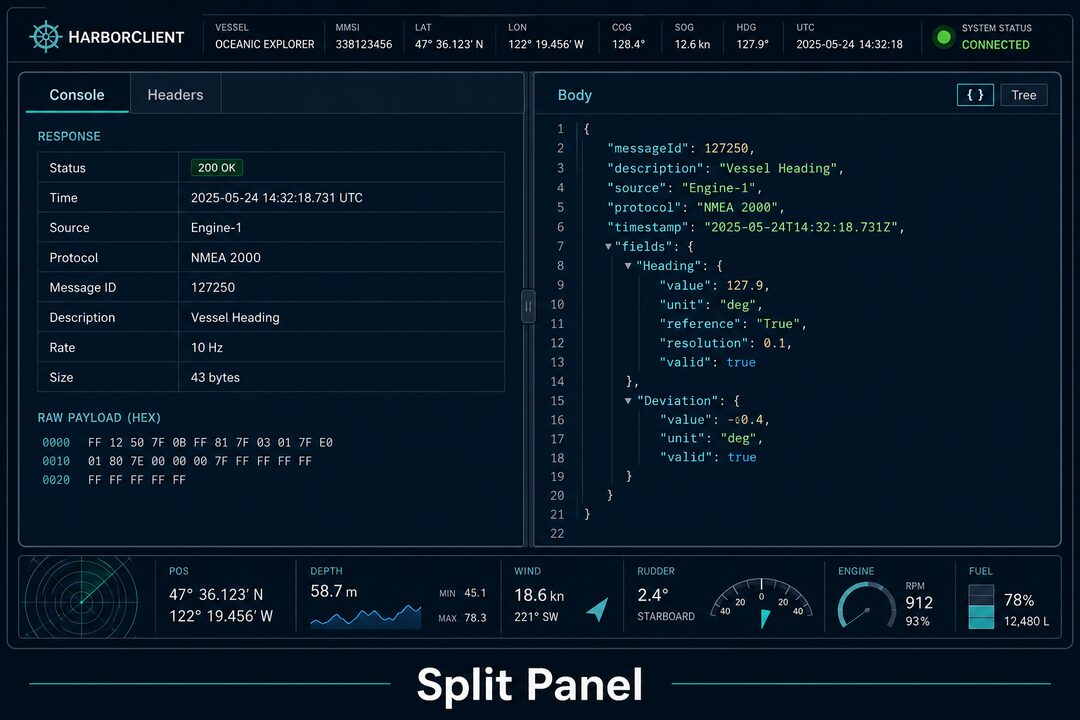
You should be able to create a request, choose a method, enter a URL, add headers, configure authentication, send the request, and inspect the response without fighting the interface. You should be able to organize requests into collections without needing to understand a company’s entire product philosophy. You should be able to switch environments without digging through clutter.
HarborClient is designed around that basic idea: make the common path obvious.
The goal is not to remove capability. The goal is to remove drag.
Built Around the Way Developers Already Work
Developers already have workflows.
They have projects. They have repositories. They have branches. They have pull requests. They have local environments, staging environments, production environments, and messy half-broken development services running on random ports.
A good API client should fit into that world.
It should not force the project to orbit around the tool. It should not require a cloud account for ordinary work. It should not make basic sharing feel like an enterprise feature. And it should not trap project knowledge inside a remote workspace when that knowledge belongs with the code.
HarborClient is built with a developer-first assumption: your API collections are part of your project.
They should be portable. They should be understandable. They should be easy to share. They should be able to live close to the code instead of being locked away in a proprietary cloud workspace.
That matters because API requests are not just temporary debugging artifacts. Over time, they become living documentation. They show how the system works. They help new developers understand the API. They help frontend and backend developers stay aligned. They help QA validate behavior. They help future-you remember what current-you was thinking.
That knowledge should not be hard to move.
Shareable Without the Nonsense
Sharing collections should be boring.
That is a compliment.
A collection is just a useful bundle of API requests. If you are working with another developer, sharing that bundle should be easy. If you are working on a team, it should be natural. If you are maintaining an open-source project, it should be possible without asking contributors to join your paid workspace.
Too many tools treat collaboration as the moment the meter starts running.
There is a difference between advanced enterprise collaboration and basic sharing. Enterprise features like centralized administration, audit logs, team permissions, compliance workflows, hosted sync, and organizational controls are real features. Those can justify a paid plan.
But sharing API examples with another developer is not enterprise governance. It is normal software development.
HarborClient is meant to respect that distinction.
The goal is simple: let developers share useful API collections without turning a basic workflow into a subscription problem.
Local-First by Default
Local-first software has a practical kind of honesty.
Your files are yours. Your project is yours. Your data does not disappear into a vendor’s workspace unless you deliberately put it there.
That model makes sense for API tooling because API clients often contain sensitive information: internal URLs, request examples, headers, authentication flows, environment variables, and sometimes tokens or secrets that should be handled carefully.
A local-first API client gives developers more control. It makes the tool feel predictable. It also makes collaboration through Git more natural. Collections can be versioned, reviewed, diffed, updated with the API, and included as part of the project’s working knowledge.
That is a cleaner model than scattering API knowledge across private cloud accounts, personal scratchpads, and half-maintained shared workspaces.
Cloud features can be useful. But they should be optional.
The local project should remain the center of gravity.
Built for Real Developers
“Real developers” does not mean some elite category of programmer.
It means people doing actual development work, with all the normal messiness that comes with it.
Real developers test unfinished APIs. They hit endpoints before the docs are ready. They switch between local and staging. They copy tokens from one place to another. They debug weird response bodies. They need to check whether the bug is in the frontend, the backend, the proxy, the auth layer, or the third-party service.
They do not need their API client to lecture them about workflows.
They need it to be fast, clear, and dependable.
HarborClient is for that kind of work. The everyday work. The practical work. The “I just need to see what this endpoint is doing” work.
That is the work API clients should serve first.
The Point Is Control
At its core, HarborClient is about giving control back to the developer.
Control over collections.
Control over sharing.
Control over where project knowledge lives.
Control over whether cloud features are involved at all.
Control over the shape of the workflow.
Developer tools are best when they respect the developer’s judgment. They should provide useful structure without taking ownership of the process. They should help teams move faster without quietly creating new dependencies. They should make the simple things simple and the powerful things possible.
That is the balance HarborClient is aiming for.
A Cleaner API Client for a Messier World
APIs are not getting simpler. Systems are more distributed. Auth flows are more layered. Teams are more remote. Local development is more complex. Testing an endpoint often means understanding half a dozen moving parts.
That makes the API client more important, not less.
But the answer is not more clutter. It is not more lock-in. It is not turning every saved request into a managed cloud object.
The answer is a tool that gives developers a clean place to work.
HarborClient is simple because the work is already complicated enough.
It is shareable because API knowledge belongs to the project, not the platform.
And it is built for real developers because real developers deserve tools that respect their time, their workflow, and their control.
That is HarborClient.


Leave a Reply